North Texas Heating Systems Guide: Furnaces, Heat Pumps & Dual Fuel
Compare gas furnaces, heat pumps and dual-fuel heating systems for North Texas homes. Learn about safety, airflow, efficiency, repairs and system selection.
Written and technically reviewed by Sergio Villarreal
Texas HVAC License: TACLB50985E
28+ years of HVAC/R field experience
Published • Updated
Heating Technical Guides
Cracked Heat Exchanger Guide: Testing, Warning Signs & Replacement
Understand heat-exchanger inspection, combustion and CO testing, documented safety findings, and when an approved repair or furnace replacement may be needed.
Read guide →
Furnace Temperature Rise and High-Limit Trips: Complete Guide
Learn how furnace temperature rise is measured, why high limits trip, and how airflow, blower settings and gas input guide diagnosis and repair decisions.
Read guide →
Dual-Fuel Balance Point Setup for North Texas Heat Pumps
Compare thermal and economic dual-fuel balance points, energy rates, heat-pump capacity, thermostat settings and commissioning for North Texas homes.
Read guide →
A heating decision is a choice about the house, the air-delivery system and the controls—not simply a choice of fuel. This guide compares the equipment families and explains which measurements make a repair, maintenance or replacement recommendation meaningful.
Heating a North Texas Home Is a Different Problem
Mild winter days and occasional hard freezes ask different things of the same system. Equipment needs to operate comfortably at light load while still meeting the home's heat loss in colder conditions. Selecting a furnace from floor area or copying an old nameplate can miss both requirements. A load calculation considers insulation, windows, infiltration and duct location; equipment selection then uses the actual manufacturer's capacity data.
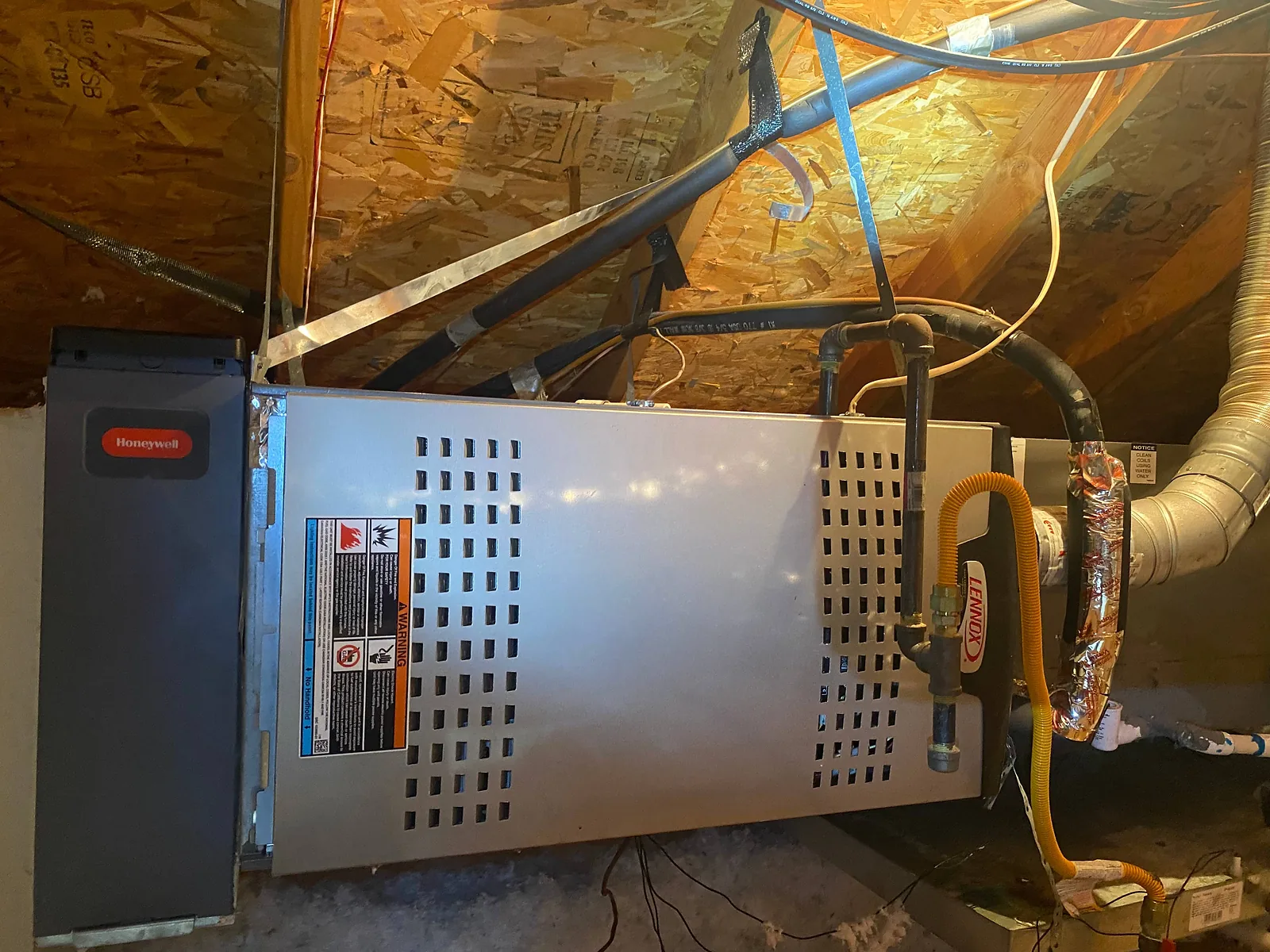
Attic installations add another layer. Heat can be lost through poorly insulated ducts before air reaches a bedroom. A crushed supply run or restricted return can reduce delivery even when the furnace produces enough heat. Horizontal equipment also needs appropriate service access, venting and condensate arrangements. Condensing-furnace drains in unconditioned space need the manufacturer's specified freeze protection where freezing is possible.
Heating does not remove moisture the way a cooling coil does. Warming air can lower its relative humidity without removing water from it. A new heating system therefore does not automatically correct a moisture problem. With a heat pump that also provides cooling, winter capacity selection must not ignore summer cooling and humidity requirements. Electric-resistance backup heat belongs in electrical and control planning, not as an afterthought when the first freeze arrives.
Gas Furnaces
A gas furnace burns fuel and transfers heat through a heat exchanger to the circulating household air. Combustion products are intended to remain separated from that air and leave through the approved vent system. Gas input, combustion air, venting, drainage where applicable and circulating airflow all affect safe operation.
Single-stage equipment has one principal firing rate. Two-stage equipment can operate at a lower or higher rate. Modulating equipment adjusts its output within its designed range. Staging can improve load matching, but neither a staged burner nor a variable-speed blower repairs undersized ducts or justifies oversized equipment.
Temperature rise is the increase from return-air temperature to supply-air temperature across the operating furnace. It must be evaluated against the installed furnace's rating-plate range and the manufacturer's measurement instructions. Excessive rise may involve insufficient airflow, excessive gas input or more than one problem. Repeated high-limit trips require diagnosis; replacing or bypassing a limit is not an airflow correction. The furnace temperature-rise and high-limit guide explains the sequence.
Gas pressure is measured with appropriate instruments and compared with requirements for the model and fuel. It is not safely set by the appearance of a flame. Heat-exchanger inspection and combustion testing provide different kinds of evidence; the cracked heat-exchanger testing and replacement guide explains what a finding can—and cannot—establish.
Heat Pumps
An air-source heat pump uses refrigerant to move heat from outdoor air into the home. In cooling mode it moves heat in the opposite direction. Heating output and electrical consumption vary with outdoor conditions and the equipment's operating stage. Published performance data for the selected combination must be compared with the home's heating load, rather than assuming that a nominal cooling size describes winter capacity.
Frost can accumulate on the outdoor coil in suitable weather. A defrost cycle removes it, commonly by temporarily reversing the refrigerant cycle. Brief changes in sound or air temperature, and water vapor near the outdoor unit, can be normal. Persistent ice, failure to resume heating or an abnormal sequence needs service. Auxiliary heat may support an all-electric system during a capacity shortfall, recovery or defrost as the approved controls require. An emergency-heat setting is not the ordinary way to improve everyday heat-pump operation.
The thermal balance point is where available heat-pump capacity equals the building's heat loss. Below that point, additional heat or another heat source may be needed. Adequate supply and return airflow remains essential: a heat pump cannot deliver its intended performance through an air-distribution system that falls outside its blower capability. Explore heat-pump sizing, airflow and performance for a deeper equipment overview.
Dual-Fuel Systems
Dual fuel combines a heat pump with a gas furnace. The heat pump handles heating when the selected operating strategy calls for it; the furnace takes over when the control logic selects gas heat. The switch can reflect capacity, operating cost, comfort or equipment limitations, but those are not interchangeable reasons.
A thermostat or communicating control must support the actual equipment combination, staging, outdoor sensing and backup sequence. Do not assume that a furnace and compressor should run together just because both can make heat. Permitted operation, including defrost support, comes from the approved system documentation. The dual-fuel balance-point setup guide covers thermal and economic changeover decisions without prescribing one universal outdoor temperature.
Dual fuel may be worth evaluating when gas service already exists, a compatible furnace can be retained, or gas backup meets the owner's cold-weather priorities. It also means maintaining both a refrigeration system and a combustion appliance. The choice should include controls, electrical needs and the condition of the entire system—not an assumed savings percentage.
Repair, Maintain or Replace?
Start by separating safety findings from comfort complaints and ordinary wear. Equipment that has a verified unsafe condition should not be kept operating while a financial comparison is made. For a repairable, otherwise suitable system, age is context—not a replacement verdict.
| Decision factor | What to establish before deciding |
|---|---|
| Safety | Documented defect, manufacturer guidance, and whether an approved repair can restore safe operation |
| Repair history | Which failures recur, whether their cause was corrected, and availability of suitable parts |
| Comfort | Capacity, room airflow, thermostat behavior and building heat loss—not just register temperature |
| Efficiency | Actual operating conditions and energy use; a laboratory rating alone does not establish installed savings |
| Duct condition | Restrictions, leakage, insulation and whether the delivery system supports proposed equipment |
| Ownership cost | Written repair and replacement scopes, maintenance, utility rates, likely supporting work and planned ownership |
Maintenance may address a serviceable filter, dirty accessible components or neglected checks. Repair may correct a specific verified failure. Replacement becomes a stronger option when an approved repair is unavailable, repeated failures accumulate, or measured capacity and condition no longer fit the home. No price or age cutoff decides every case. Duct corrections can remain necessary under either option.
Heating Diagnostics
A useful assessment records the complaint, operating mode, outdoor conditions, model numbers and control history before assigning a cause. The tests below answer different questions:
- Temperature rise: Is the furnace operating within its specified range at the tested firing stage?
- Static pressure and airflow: Can the blower deliver the required air through the actual filter, coil and ducts? Pressure readings need the correct test locations and manufacturer blower data.
- Gas pressure and input: Does fuel delivery match the model and fuel requirements under operation? These checks are technician work.
- Combustion testing: What do flue measurements indicate about combustion under the tested conditions? Results must identify where and how the sample was taken.
- Heat-exchanger inspection: Is there documented cracking, separation, corrosion or another defect, and were inaccessible areas considered?
- Electrical testing: Are supply voltage, connections, motors and controls functioning under the applicable load?
- Thermostat verification: Are equipment type, staging, sensors, recovery, lockouts and backup heat configured correctly?
A fault code is a starting point, not proof that the named component needs replacement. After correction, repeat the relevant checks and document the resulting operation. Homeowners should not adjust gas valves, remove combustion components or defeat safety controls.
Safety Warning Signs
Persistent combustion odors, soot, unusual flame behavior, repeated limit trips and unexplained shutdowns warrant professional evaluation. A fuel-gas odor also needs immediate action from outside the building; avoid flames or operating electrical switches inside and contact the gas utility or emergency services.
If a carbon-monoxide alarm sounds or poisoning is suspected, occupants should leave the building immediately and contact emergency services from outside. Do not stay inside to troubleshoot, and do not re-enter until responders say it is safe. Seek urgent medical help for suspected exposure.
Headache or nausea can occur with CO exposure, but these symptoms have other causes and do not diagnose a furnace defect. CO itself is odorless: no smell does not establish safety. A quiet alarm or one normal reading does not replace correct installation, maintenance and investigation of a suspected hazard.
North Texas Heating-System Comparison
| System | Operating characteristics | Cold-weather backup | Comfort | Maintenance considerations | Typical applications |
|---|---|---|---|---|---|
| Gas furnace | Produces heat by combustion; single-stage, two-stage or modulating operation | Furnace supplies heat; capacity must meet the load | Often warmer supply air; distribution still depends on ducts | Combustion, venting, exchanger, fuel delivery, blower and controls | Homes with gas service and a suitable venting/installation arrangement |
| Heat pump | Moves heat; capacity and efficiency depend on conditions and equipment | Planned electric auxiliary heat or other approved support when needed | Longer runs can be normal; supply air differs from furnace air | Refrigerant circuit, coils, defrost, airflow and auxiliary controls | Homes where load, electrical capacity and equipment performance support all-electric heating |
| Dual fuel | Selects heat-pump or furnace operation through compatible controls | Gas furnace replaces heat-pump heating according to the approved strategy | Changeover and staging affect recovery and air temperature | Both heat-pump and furnace maintenance, plus changeover verification | Homes where retaining or adding gas backup makes practical sense |
| Electric air handler with heat strips | Resistance elements create heat; no combustion at the heater | Heat strips are the heat source, not a second compressor-based mode | Air temperature depends on energized stages and airflow | Electrical connections, sequencers/relays, limits and blower | Homes using resistance heating with separately provided cooling; verify electrical service and operating cost |
No row guarantees lower bills. Compare delivered heat, local rates, equipment performance and the actual installation before choosing.
Related Heating Resources
For equipment-specific decisions and service needs, continue with these existing resources:
- Furnace replacement and heating installation
- Diagnostic-first furnace and heating repair
- Heating tune-up and maintenance
- Heat-pump repair in Grapevine and DFW
- Planning heat-pump electrification
- Incomplete combustion in North Texas homes
- Burning smells when heat starts
- Safe no-heat troubleshooting
- Carbon-monoxide exposure and home safety
- Thermostat installation and controls
- Heat pumps versus furnaces in Texas
- Dual-fuel system selection
Sources & References
- CDC — Carbon monoxide safety
- EPA — Sources of combustion products
- Trane — Example furnace installation instructions — use the instructions for your installed model
- ComEd — Heat-pump switchover guide: thermal and economic balance points
- DOE Building Science Education — Controls for a heat pump with secondary heating
Independent educational references do not imply endorsement of Too Cool Air. Model-specific instructions govern equipment testing and setup. This guide does not replace an on-site assessment.