AC Repair in Grapevine & the Mid-Cities, TX
AC and HVAC Repair in Grapevine & DFW — Professional Diagnosis, Not Guesswork
Not Everybody Needs a New Air Conditioner
Too Cool Air performs diagnostic-first AC repairs using calibrated instruments and performance testing—not guesswork. Every repair is backed by comprehensive workmanship warranties and 28+ Years in North Texas HVAC service.
When your AC stops working in a Texas heat wave, accurate diagnosis matters. We understand North Texas AC problems caused by extreme heat, humidity, airflow restrictions, and systems pushed beyond their design limits. Serving Grapevine, Southlake, Colleyville, and surrounding areas, we diagnose and repair AC failures with a performance-based approach built for DFW conditions. For recurring comfort problems, our Comfort Audit identifies root causes, and for major system failures we can also guide HVAC installation options. We also address indoor air quality issues that affect comfort, airflow, and system performance. Licensed TACLB50985E, with upfront pricing and workmanship warranties built for harsh Texas summers.
Residential HVAC repair covers more than the outdoor unit. A cooling complaint can originate in the electrical circuit, the refrigerant circuit, the duct system, the condensate path, or the thermostat and control wiring — and those five areas produce very different repairs. The sections below explain how each is diagnosed, what the readings mean, and where repair stops making financial sense.
Diagnostic-First AC Repairs—Not Parts-Swapping Guesswork
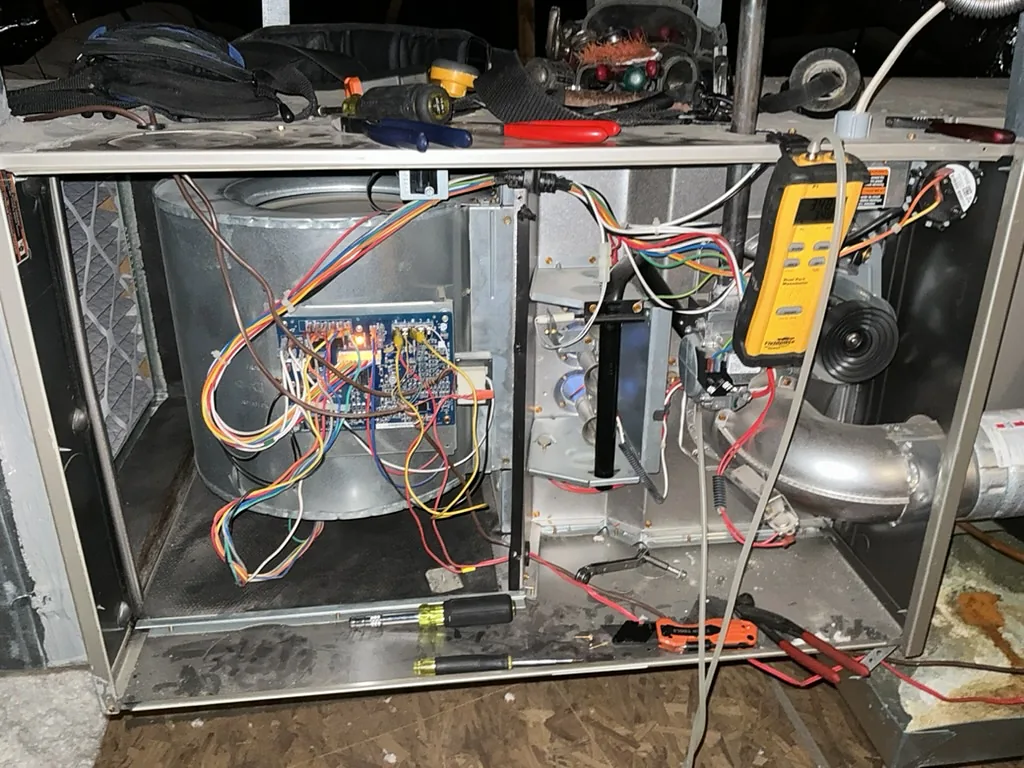
Most AC service calls end with replaced parts but no performance testing. We use calibrated instruments to measure airflow, static pressure, superheat, subcooling, and system performance before and after repairs. This diagnostic-first approach identifies root causes—not just symptoms—and ensures your AC runs efficiently after we leave.
Every system is designed using:
- Airflow measurement using digital anemometers and static pressure mapping
- Refrigerant charge verification with superheat and subcooling calculations
- Electrical testing on all components including compressor, fan motors, and capacitors
- Duct system inspection to identify leaks affecting system performance
- Post-repair performance testing to verify proper operation and efficiency
This is why we diagnose first—not just swap parts and hope it fixes the problem.
North Texas AC Repair Authority Backed by 28+ Years of HVAC Experience
Too Cool Air has been diagnosing and repairing AC systems across Grapevine, Southlake, Colleyville, Coppell, Flower Mound, Keller, Trophy Club, Westlake, Roanoke, Argyle, Denton, and Highland Village for 28+ years. We understand North Texas heat loads, high-efficiency systems, and the specific AC challenges Texas homeowners face every summer. Learn more about our DFW HVAC Performance Authority.
📚 Learn More
Visit our Learning Center for answers to common HVAC questions, buying guides, and maintenance tips.
Related Systems & Guides
The engineering behind this service, explained for homeowners.
How Much Does This Service Cost in North Texas?
Texas-specific factors: Extreme heat accelerates wear on capacitors and contactors. High humidity increases coil corrosion. Extended cooling season means more system strain. We provide upfront pricing before starting work—no surprises. Published prices are planning ranges for standard residential projects. Final pricing depends on equipment type, capacity, accessibility, refrigerant requirements, installation conditions and the approved scope of work. Too Cool Air provides the final written price before work begins.
Benefits
- Priority AC repair during Texas heat waves—we focus on urgent cooling failures
- Experience with North Texas AC systems exposed to 100°F+ temperatures and high humidity
- Warranty coverage designed for harsh Texas climate conditions—repairs that last
- 28+ years solving AC failures specific to DFW heat and system strain
- Comprehensive diagnostic testing identifies problems caused by Texas heat stress
Our Process
Schedule your service at a time that works for you
Technician performs comprehensive diagnostics with calibrated instruments
Receive detailed explanation and upfront pricing before we start
We complete your repair and verify proper system operation
Follow-up to ensure you're satisfied with the repair
Electrical and Control Failures
Electrical components are the most common cause of a sudden no-cool in North Texas, because heat is hard on them. A run capacitor that has drifted below its rated microfarads will let a motor hum without starting. A pitted contactor may chatter or weld closed. A failed transformer, a tripped float switch, a blown low-voltage fuse or a rodent-chewed thermostat wire can stop a healthy system cold.
Diagnosis is measurement, not substitution. We check incoming voltage and voltage drop under load, capacitor microfarads against the nameplate, amp draw on the compressor and both motors, and continuity through the safety and control circuits. That distinguishes a $200 capacitor from a $2,000 compressor — a distinction that gets guessed at far too often.
Control faults deserve their own attention. A thermostat set to the wrong system type, a mis-wired changeover, or a board with a failed relay produces symptoms identical to mechanical failure. Confirming the control sequence before condemning equipment is one of the cheapest steps in the whole process.
Refrigerant-Circuit Diagnosis
Refrigerant does not get used up. If a system is low, it is leaking, and adding refrigerant without locating the leak means paying for the same repair again next season. We verify charge properly — superheat on a fixed-orifice system, subcooling on a TXV system — rather than reading suction pressure and guessing.
Leak location uses electronic detection, bubble solution, and where necessary nitrogen pressure testing. Common leak points in this climate are evaporator coil tubing, Schrader valves and service ports, brazed joints on the line set, and corrosion where a line set passes through a wall or sits in an attic.
Not every refrigerant symptom is a leak. A restricted metering device, a plugged filter drier, a dirty condenser coil or an overcharged system all skew pressures. The full picture — pressures, superheat, subcooling, air temperatures and amp draw — tells you which of those you actually have.
Airflow and Static Pressure
Airflow is the most under-diagnosed problem in residential HVAC and one of the most common in DFW homes, where returns are often undersized and flex duct runs long distances through a hot attic. Total external static pressure tells you immediately whether the blower is fighting the duct system.
High static pressure starves the coil, drives the system toward freezing, shortens blower and compressor life, and makes distant rooms uncomfortable no matter what the thermostat says. It is also frequently mistaken for a refrigerant problem, because a starved coil produces low suction pressure.
We measure supply and return static, airflow across the coil, and pressure drop across the filter, then compare those numbers to the equipment's rating. Correcting a crushed flex run, a closed damper, an oversized-MERV filter or an undersized return often restores more cooling than any part replacement would.
Temperature Split
Temperature split is the difference between the air entering the return and the air leaving the supply. On a properly performing system in a humid climate it generally lands in the high teens to low twenties in degrees Fahrenheit, and it must be interpreted alongside indoor humidity and airflow rather than on its own.
A split that is too small usually means low capacity: low charge, a dirty coil, a failing compressor, or too much airflow. A split that is too large usually means too little airflow — a dirty filter, a blocked coil, a failed blower speed tap, or duct restriction. Reading the split first tells us which direction to investigate before anything is opened up.
Drainage Failures
Attic-mounted air handlers are the norm across Grapevine and the Mid-Cities, and a clogged condensate drain in an attic becomes a ceiling repair fast. Biological growth in the drain line, a sagging or improperly sloped trap, a failed condensate pump, or a rusted secondary pan are all routine finds during hot, humid weeks.
A float switch that shuts the system down is doing its job, not malfunctioning. When we are called for a system that stops and starts on its own, the drain and float circuit are checked early. We clear the line, verify the trap and slope, test the float switch, and confirm the secondary pan can actually catch water if it is ever needed.
Compressor and Capacitor Diagnosis
A compressor that will not start is not automatically a failed compressor. The far more common causes are a weak run capacitor, a burnt contactor, low incoming voltage, or a failed start component. Those are inexpensive repairs, and skipping the test that finds them is how homeowners end up quoted a new system unnecessarily.
When a compressor genuinely has failed, we confirm it: winding resistance, insulation resistance to ground, locked-rotor amp draw, and whether the internal overload is open. A true electrical failure to ground or a mechanically locked compressor is documented and shown to you before any replacement is discussed.
We also look for the cause. A compressor that failed from high head pressure due to a filthy condenser coil, or from returning liquid refrigerant because of a duct or charge problem, will fail again if only the part is replaced.
Repair Versus Replacement
Repair generally makes sense when the equipment is mechanically sound, the failed component is available, and the real limitation is not the equipment itself. Airflow problems, duct leakage and attic heat gain follow you to new equipment — replacing the condenser without correcting them buys an expensive version of the same complaint.
Replacement generally makes sense with a failed compressor or a leaking evaporator coil outside parts warranty, R-22 equipment with an active leak, repeated repairs across consecutive seasons, or a system that is genuinely mis-sized for the measured load. We present the numbers and the options rather than a single recommendation, and we are glad to be told no.
What You Can Safely Check Before Scheduling Service
A few checks are safe, take five minutes, and occasionally solve the problem outright. Anything involving opening an electrical panel, touching a capacitor, or handling refrigerant is not on this list — capacitors store a dangerous charge even with the power off.
- Confirm the thermostat is set to COOL, the fan to AUTO, and the setpoint below room temperature; check the batteries
- Look at the filter — if it is grey and loaded, replace it and give the system time to recover
- Check the breaker for the indoor and outdoor units, and the switch on or near the air handler; if a breaker trips again, stop and call
- Look for ice on the refrigerant lines or coil; if you see ice, switch to FAN ONLY to thaw it and leave the cooling off
- Check for standing water in the secondary drain pan or a full condensate pump reservoir
- Clear grass, mulch, patio furniture and shrubs at least two feet back from the outdoor unit so it can reject heat
- Make sure supply and return vents are open and not blocked by rugs or furniture
North Texas Conditions That Drive AC Failures
Our cooling season is long, our design temperatures are high, and our humidity is significant. Equipment here accumulates far more run hours than the same equipment would in a milder climate, which is why capacitors, contactors and condenser fan motors are the parts we replace most.
Attic-installed air handlers add heat gain and drainage risk, long flex-duct runs add static pressure, and late-summer heat waves expose any system already operating with marginal airflow or charge. Documenting readings each visit is what makes a pattern visible before it becomes a failure.
What Our Clients Say
Our reviews live on our public Google Business Profile, where every rating comes from a verified customer.
Read Our Verified Google ReviewsHVAC Service FAQs
Get answers about our HVAC services in Grapevine & DFW
Related Services You Might Need
Technical Sources
- U.S. Environmental Protection Agency — SNAP substitutes for residential and light commercial air conditioning and heat pumps
- AHRI — AHRI Directory of Certified Product Performance
- Texas Department of Licensing and Regulation — Air Conditioning and Refrigeration Contractors program
- Air Conditioning Contractors of America (ACCA) — Residential Technical Toolbox (Manual J, D and S guidance)
These references provide general industry, regulatory and public-health guidance. Their inclusion does not imply endorsement of Too Cool Air.
Too Cool Air is based in Grapevine, TX. See HVAC services in Grapevine or browse the full service areas.
Get Cold Air Back Today
Schedule your service today. 28+ years of honest, diagnostic-first HVAC service.