Furnace Replacement & Heating Installation in Grapevine, TX
Heating Contractor in North Texas | Furnace Replacement & Heat Pump Installation
Not Every Home Needs a New Heating System
Too Cool Air designs heating systems based on your home's actual heating load—not rules of thumb or square footage guesses. We perform Manual J load calculations, verify airflow and duct design, and evaluate total system performance—not just equipment size—so heat pumps, dual-fuel systems, and gas furnaces are matched to North Texas temperature and humidity swings. For recurring comfort problems, our Comfort Audit helps identify root causes, and we also address indoor air quality issues that affect comfort, airflow, and overall heating performance. Every installation is backed by 28+ Years in North Texas HVAC service. Compare the equipment families in our North Texas heating systems guide.
Furnace replacement is a bigger decision than picking a model number. Sizing, venting, combustion air, the condition of the existing ductwork and the physical constraints of a horizontal attic installation all determine whether the new equipment performs the way the label promises. The sections below cover when replacement is genuinely justified, when repair is still the better decision, and exactly what we verify before and after installation.
- Manual J load calculations for accurate heating capacity sizing
- Airflow verification and duct design assessment for proper heat distribution
- Equipment sizing matched to North Texas temperature and humidity swings
- Combustion and safety testing for applicable gas heating systems
- Post-installation performance verification to confirm proper operation
Engineered Heating Solutions—Not Generic Equipment Sales
Most heating contractors sell equipment based on what fits the existing space or what earns the biggest margin. We design heating systems around your home's actual performance data. Comfort isn't just about BTU capacity—it's about airflow, duct integrity, and system balance. An oversized furnace short-cycles, wastes energy, and creates temperature swings. An undersized heat pump runs constantly without reaching comfort. We get it right.
North Texas Heating Installation Authority Backed by 28+ Years of HVAC Experience
Too Cool Air has been installing heating systems across Grapevine, Southlake, Colleyville, Coppell, Flower Mound, Keller, Trophy Club, Westlake, Roanoke, Argyle, Denton, and Highland Village for 28+ years. We specialize in heat pump systems, dual-fuel configurations, and high-efficiency gas furnaces designed for North Texas conditions.
📚 Learn More
Visit our Learning Center for answers to common HVAC questions, buying guides, and maintenance tips.
Related Systems & Guides
The engineering behind this service, explained for homeowners.
How Much Does This Service Cost in North Texas?
Pricing varies by system type, capacity, and ductwork requirements. Exact pricing provided after Manual J load calculation and on-site assessment.
Benefits
- Engineering-based heating system design using Manual J calculations—not square footage guesses
- Furnace replacement scoped with venting, combustion air and duct compatibility included in writing
- Heat pump and dual-fuel system specialists for North Texas climate
- Authorized Amana/Goodman dealer with manufacturer-backed warranties
- 28+ years installing heating systems optimized for North Texas winters
- Post-installation combustion analysis and performance verification on every job
Our Process
Schedule your in-home consultation at a time that works
We assess your home's heating needs with Manual J load calculations
Receive detailed proposal with system options and upfront pricing
Professional installation by our licensed technicians
Post-installation performance testing and system commissioning
When Furnace Replacement Is Justified
Replacement earns its cost under specific conditions — not simply because a furnace has a date on it. These are the findings that genuinely justify replacing rather than repairing a North Texas furnace:
- A cracked, rusted-through or failed heat exchanger confirmed by inspection — a safety condition, not an efficiency one
- A major component failure such as a heat exchanger or gas valve on equipment past its expected service life
- Replacement parts no longer available for the model, or available only at a cost approaching a new unit
- Repeated failures across consecutive winters whose combined cost approaches a meaningful share of replacement
- Combustion testing that cannot be brought into a safe range after repair
- Capacity that is genuinely wrong for the measured load, causing permanent comfort or humidity problems
- A planned cooling replacement on a shared air handler, where doing both at once avoids paying twice for the same labor
When Repair Remains the Better Decision
Plenty of furnaces we are called to replace do not need replacing. An ignitor, flame sensor, pressure switch, inducer motor, blower motor, capacitor, control board or gas valve on a structurally sound furnace is normally worth repairing — especially when combustion tests clean afterward.
The same is true when the actual complaint is not the furnace. Cold back bedrooms, uneven temperatures between floors and short cycling are frequently duct, airflow and insulation problems. New equipment inherits all three, so replacing a working furnace to solve them produces an expensive version of the same complaint. We measure first and tell you which situation you are in, including when the honest answer is that you do not need us to sell you anything.
Horizontal Attic Furnace Considerations
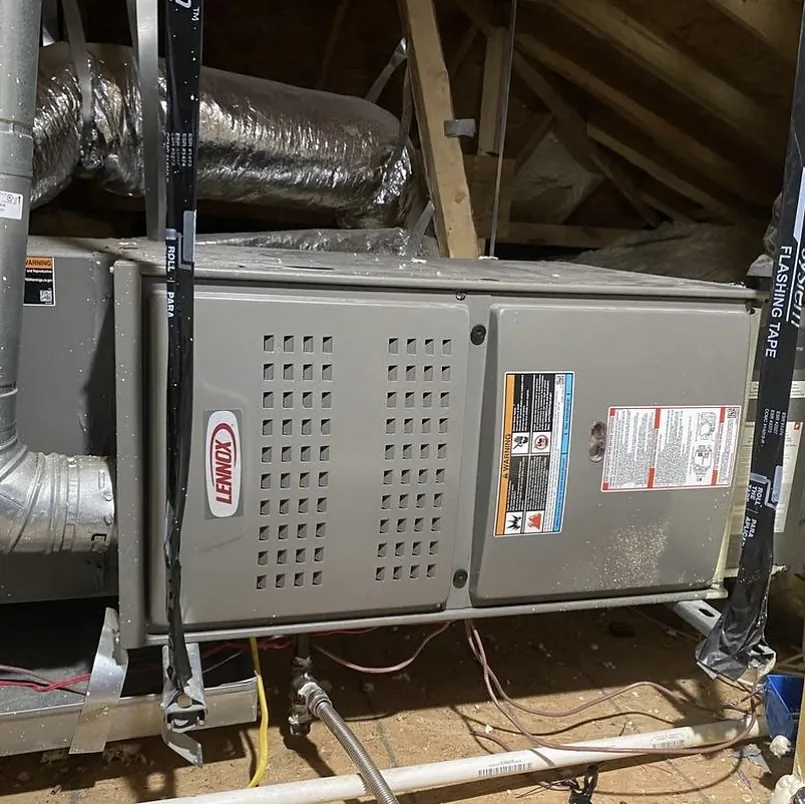
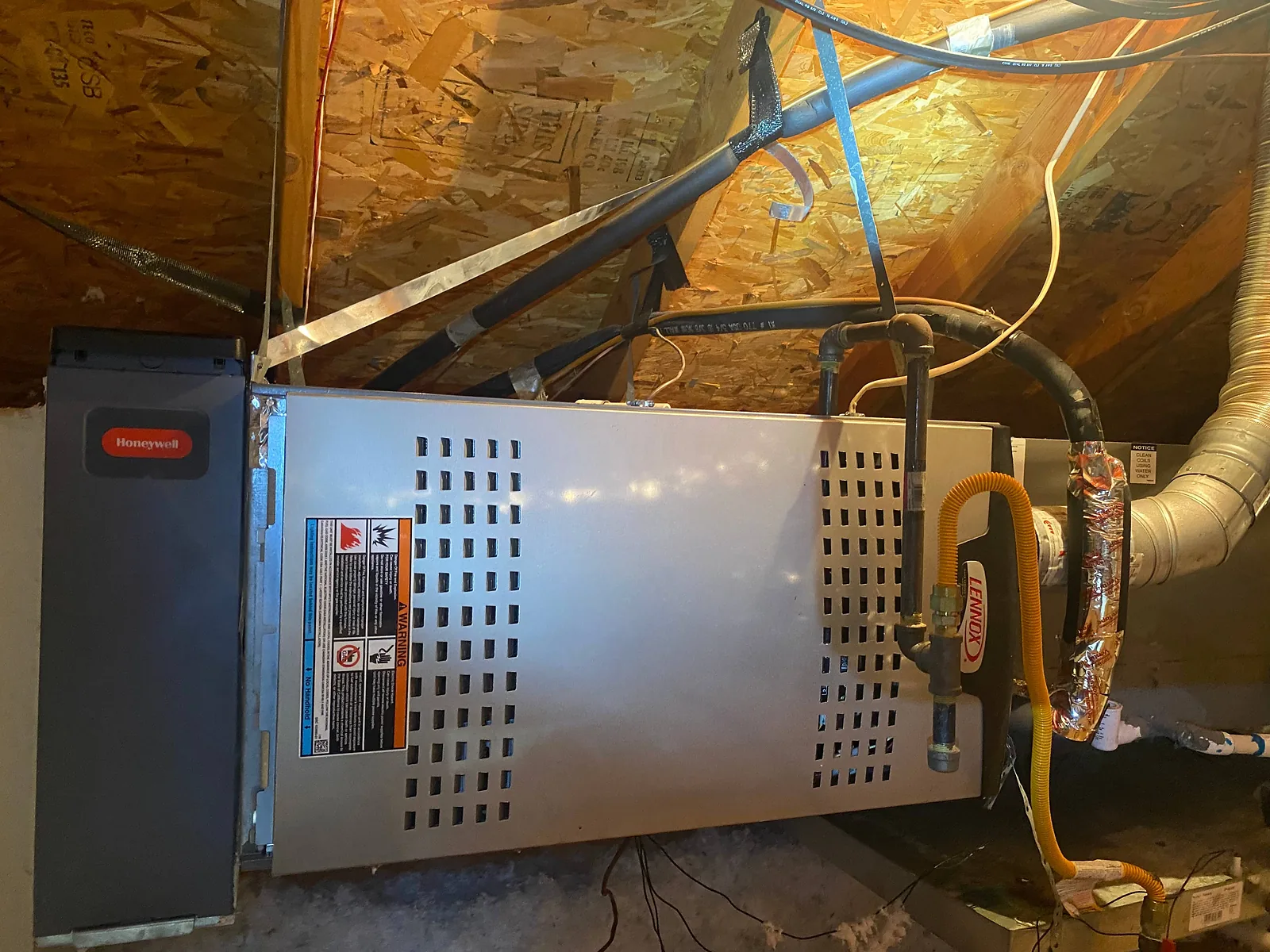
Most Mid-Cities homes have the furnace lying horizontally in the attic, and that configuration drives much of a replacement's real scope. Height and width clearances above the platform, the walkway and access path, the physical route to get old equipment out and new equipment in, and the structural condition of the platform all have to be verified before a model is selected — not discovered on installation day.
Horizontal installations also change drainage. The cooling coil sits in the same cabinet, so the primary drain, the trap, the secondary pan and the float switch all need to be correct or a summer clog becomes a ceiling repair. High-efficiency condensing furnaces add their own condensate, which must be drained and, in an unconditioned attic, protected from freezing during a hard freeze.
Finally, an attic furnace loses heat through every foot of duct in that attic. Where duct insulation is thin or leaking, we quantify it and include the correction in the proposal, because otherwise a properly sized new furnace still delivers disappointing air to the farthest rooms.
Combustion Safety and Venting
A furnace replacement is a combustion appliance installation, and venting is where corners get cut in this market. An 80% furnace vents through metal flue pipe with required slope, clearances and terminations; a 90%-plus condensing furnace vents through PVC with its own length, slope, termination and drainage rules. Reusing an existing flue that does not match the new equipment category is a safety problem, not a shortcut.
Combustion air matters just as much. A furnace in a closed mechanical closet, or in a tight home with powerful kitchen and bath exhaust, can be starved or backdrafted. We evaluate the space, verify the vent path, and check for negative pressure conditions caused by return-duct leaks in the attic or garage.
After startup we run a combustion analysis: CO, CO2, flue gas temperature and firing rate against the nameplate, with the readings documented for you. We also confirm gas pressure at the inlet and manifold with a manometer instead of assuming the factory setting is correct at your gas supply.
Furnace Sizing and Manual J
A Manual J load calculation determines how much heat your home actually loses at our local winter design temperature, accounting for wall and attic insulation, window area and type, infiltration, duct location and leakage, and orientation. It replaces the tons-and-BTUs-per-square-foot habit that produces oversized equipment almost every time.
Oversizing a furnace is easy and consequential. An oversized furnace satisfies the thermostat quickly, short cycles, swings temperature between rooms, and runs the blower in bursts too short to even out the house. It also costs more to buy and stresses the heat exchanger with frequent heat-up and cool-down cycles.
Replacing like-for-like is not a substitute for a calculation, because the original equipment may have been oversized to begin with, and because windows, insulation, additions and duct work often changed since. Two-stage and modulating furnaces provide additional tolerance by running longer at lower output, but they are not a fix for a load nobody measured.
Gas Furnace Versus Heat-Pump Options
North Texas supports all three configurations. A gas furnace paired with straight AC heats strongly and reliably through a hard freeze and is the most common setup in the area. It requires gas service, correct venting and combustion air.
A heat pump handles the large majority of our mild winter hours efficiently using a single piece of equipment for heating and cooling, with electric auxiliary heat for the coldest hours. Supply air is cooler than furnace air — comfortable, but noticeably different, which is worth knowing before you choose. It needs adequate electrical capacity for the auxiliary heat strips.
A dual-fuel system pairs a heat pump with a gas furnace and switches to gas below a set balance point: efficient through the long shoulder seasons, dependable during a freeze. It costs the most up front and requires a compatible thermostat and correct balance-point setup. Which option fits depends on gas availability, electrical service, how long you plan to stay in the home, and how you weigh operating cost against installed cost. We lay out all three with real numbers rather than steering you.
Airflow and Duct Compatibility
New heating equipment inherits your existing duct system. If the returns are undersized, the trunk is restrictive, or flex runs are crushed and leaking, the new furnace will operate at high static pressure from the first day, deliver less air than rated, and may trip its high limit during cold weather.
Before quoting, we measure total external static pressure and airflow and evaluate duct sizing against Manual D. Blower capability has to match the duct system that actually exists — a variable-speed blower will compensate by working harder and consuming more energy, not by fixing a restriction.
Any duct modification we consider necessary appears in the written scope with its price, so it is never discovered mid-installation. Where a return is genuinely undersized, adding return capacity often improves comfort more than the equipment upgrade itself.
Installation Verification
Commissioning is what separates an installed furnace from an assembled one. After startup we verify gas pressure at the inlet and manifold, confirm firing rate against the nameplate, run a combustion analysis for CO and CO2, and measure flue gas temperature.
We then set blower airflow to the design value, measure temperature rise across the heat exchanger and confirm it lands inside the manufacturer's published range, verify every safety control including the limit, pressure switch, rollout and flame sensing, and check the condensate path and float switch on the cooling side of the cabinet.
You receive those readings in writing along with the permit and warranty registration. Equipment change-outs require a mechanical permit in Grapevine and the surrounding Mid-Cities; we pull it, do the work to code, and meet the inspector. Licensed TACLB50985E.
Realistic North Texas Furnace-Replacement Cost Factors
The ranges published above are honest starting points, and the variation inside them is driven by identifiable factors rather than by margin games. What actually moves a furnace replacement price in this market:
- Equipment category: an 80% furnace versus a 90%-plus condensing furnace, which requires new PVC venting and condensate drainage
- Single-stage versus two-stage or modulating equipment, and the blower type that comes with it
- Required capacity from the Manual J result, and whether the existing capacity was correct
- Venting work: whether the existing flue can legitimately be reused for the new equipment category
- Duct and return modifications the static-pressure readings show are necessary
- Attic access, platform condition, and the difficulty of removing and placing equipment
- Electrical work, disconnects, and adequate capacity for heat-pump auxiliary heat
- Thermostat and controls, including an outdoor sensor for dual-fuel balance-point operation
- Condensate handling and freeze protection for a condensing furnace in an unconditioned attic
- Permit and inspection requirements, which vary by jurisdiction
- Whether cooling equipment is being replaced at the same time, which shares labor and lowers the combined cost
What Our Clients Say
Our reviews live on our public Google Business Profile, where every rating comes from a verified customer.
Read Our Verified Google ReviewsHVAC Service FAQs
Get answers about our HVAC services in Grapevine & DFW
Related Services You Might Need
Technical Sources
- Centers for Disease Control and Prevention — About Carbon Monoxide Poisoning
- Centers for Disease Control and Prevention — Furnace Safety Fact Sheet
- Texas Department of Licensing and Regulation — Air Conditioning and Refrigeration Contractors program
- Air Conditioning Contractors of America (ACCA) — Residential Technical Toolbox (Manual J, D and S guidance)
These references provide general industry, regulatory and public-health guidance. Their inclusion does not imply endorsement of Too Cool Air.
Too Cool Air is based in Grapevine, TX. See HVAC services in Grapevine or browse the full service areas.
Engineered Heating — Built for North Texas
Performance-based heating installation backed by 28+ years of expertise.
Schedule your service today. 28+ years of honest, diagnostic-first HVAC service.